

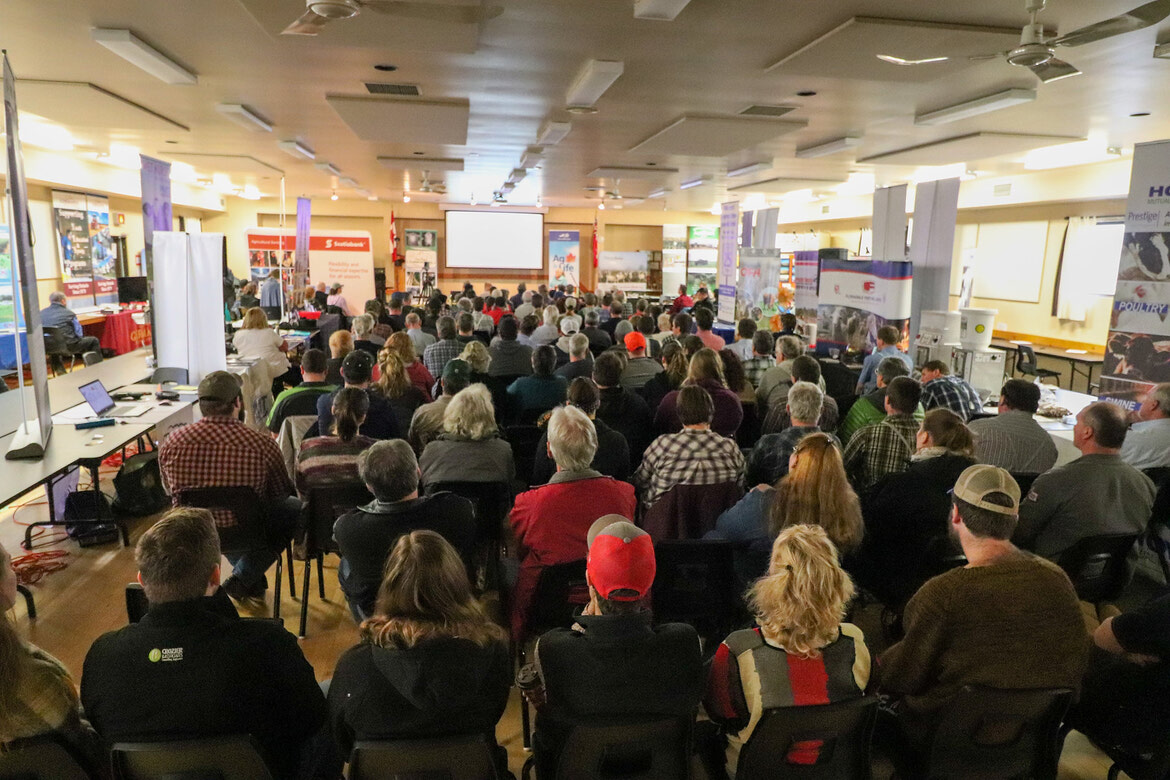
Sixty years of Grey Bruce Farmers Week
By Mel Luymes
For a week every January, farmers in Grey and Bruce Counties brave the snowy roads and crowd their trucks into the parking lot of the Elmwood Community Centre. Inside, they are greeted with the smell of a roast beef lunch coming from downstairs. They register with the friendly staff at Grey Ag Services and local volunteers from the OFA. Maybe they’ll even see Lorie Smith, long-time coordinator of the event, zooming by.
The space is cozy, filled with neighbours and friends, old and new, with a buzzing trade show wrapped around the room. Farmers take a seat as the program begins, listening to speakers focusing on commodity-specific topics.
This year, you can catch Beef Day on Wednesday January 7, Dairy Day (Jan 8), Goat Day (Jan 9), Sheep Day (Jan 10), Horse Day (Jan 11) and Crops Day (Jan 12) – six days of learning that you can get, either from Elmwood or live-streamed to your living room, along with the recordings and other on-demand sessions you can watch online for up to 30 days afterwards.
Each day is chock-full of speakers, industry updates and farmer panels. This year, there is an all-star packed session about autonomous farming on Crops Day, a market outlook on Beef Day by Anne Wasko (Gateway Livestock, AB) and a session on Dairy Day about succession planning for dairy farms by Robert Scriven (Bennett Grant LLP). And if you miss those, there are still a host of courses the Grey Ag Services runs out of their office the rest of the winter.
Attending the Grey Bruce Farmers’ Week is something of a tradition to many Rural Voice readers, but not every area of the province is fortunate to have the opportunity. Now celebrating its 60th year, this is the last remaining Farmers’ Week in Ontario.
And all because a few local champions refused to quit.
Grey Bruce Farmers’ Week (GBFW) began in 1966 in Hanover and after 20 years there, it moved north along the Grey-Bruce line to Chesley. In 1986, according to the original program kept at the Grey Ag office, the cost of registration and lunch was seven dollars. In 1998, the event moved to the Elmwood Community Centre. Each day focused on a different commodity and would draw a different crowd. Throughout the years, there has always been a Beef, Dairy and Crops Day on the program, but there has also been an OFA Day, Swine Day, Rabbit Evening, etc. and in 1998 they had a Ratite Day. (That’s not a typo – a ratite is a flightless bird and Ratite Day brought out ostrich, emu and rhea farmers from the area.)
Some will also recall the time Eugene Whelen, then the Minister of Agriculture under Prime Minister Pierre Trudeau’s Liberal government spoke to perhaps the largest turnout ever at GBFW, in Hanover on January 3rd, 1977.
There was a time when every County or group of Counties had a (typically) four-day Farmers’ Week, run by what was then called the Department of Agriculture, says Andrew Barrie, Environmental Specialist at the Ontario Ministry of Agriculture, Food and Agribusiness (OMAFA). Over the last decades, the provincial agricultural ministry has made some big changes (on top of the switch of its name every few years), including the funding and de-funding of its agricultural extension services.
“Back then, there was a good number of extension staff that went across Ontario, and education was a key part of their responsibility,” says Andrew. “There were commodity specialists, ag reps that were more generalists, and home economists too,” he adds, and there was much more provincial involvement in the 4-H program and Junior Farmers back then.
Andrew Barrie wasn’t there from the beginning, mind you. He was born and raised on a farm in Waterloo County, studied at the University of Guelph and then became a soil conservation advisor for the Grand River Conservation Authority before joining the Ministry of Agriculture, leaving for a time to be a youth pastor. When he joined the Markdale office in 1999, he was backfilling for Joan McKinley as she went on a maternity leave (for her son, Robert!)
“The Farmers’ Weeks were initiated by the Ministry to pull the people in and say what are the issues? What are the topics you want to hear? So, from the get-go, it was a collaboration,” continues Andrew. “I think that's the real key.”
Andrew would have run GBFW 2000 for both the first and last time that winter; the Ministry did a major restructuring while Joan was on leave. Under Premier Mike Harris’ Conservative government (1995-2002), agricultural extension was cut dramatically.
When the Ministry knew they would be pulling out of the coordination of GBFW, they assembled a meeting of farm organization and commodity group representatives to see if they could decide next steps.
Simon DeBoer, a dairy farmer near Tara, attended as a representative of the Bruce County Christian Farmers Federation that day in April 2000. The meeting was in Walkerton and Simon recalls that the streets were wet from the flushing of the town’s water lines, which would become more significant in the E. Coli outbreak the following month, and the subsequent Walkerton Inquiry.
“When I left that day, my wife told me not to join another board,” Simon laughs. Well, Simon didn’t listen and wound up joining a small, four-member board with Bill Herron, Don Grant and Ken Mitchell that would become the first GBFW committee. Their first order of business was to find an organization or coordinator to run GBFW. They put an advertisement in the paper and received 14 responses. They went with the strongest candidate: Ray Robertson and the (very) newly formed, Grey Ag Services.
Ray Roberston remembers that time well. April 30, 2000 was the day that most of the ag offices in the province closed their doors for good. Grey County’s Markdale office closed, Bruce County’s Walkerton office closed and so did Perth County’s Rostock office. The Clinton office in Huron County still housed a few provincial staff, though it no longer operated as the ag office used to.
The reason Ray remembers the day is because on May 1, 2000, the very next day, he opened Grey Ag Services, a fee-for-service communication hub that would carry on the work of agricultural extension for local farmers.
Ray had a few months warning about the Ministry’s closures, and he knew what he needed to do. Ray was a dairy farmer, born and raised near Markdale. He even attended one of the area’s last one-room schoolhouses. Once a shy, farm kid, he blossomed into a leader through his involvement in Junior Farmers and went on to work as a field representative for the Ontario Soil and Crop Improvement Association (OSCIA) with the newly developed Environmental Farm Plan (EFP). He worked out of the Ministry’s ag office in Markdale for 13 years.
When the news came about the Ministry’s cutbacks, he didn’t waste any time. He approached Grey County Council with the idea of a farmer-centered agricultural service hub, along with 23 strongly worded letters of support from local farm organizations. Ray secured a Trillium grant, office space (eventually) in the walk-out basement of the County’s newly-built nursing home and he began to take contracts – the first of which was the coordination of GBFW.
Ray admits that he lost $500 the first year running GBFW, but that the Committee thought the event went well and Grey Ag Services was hired on to keep running it for the next years.
“There was a real need for a service centre in the County,” says Ray, noting that Grey Ag Services offered the use of their boardrooms to agricultural groups free of charge. Those rooms were used 300 times a year, he reported back to the County. Grey County continues to offer the space at 206 Toronto Street South in Markdale for free to Grey Ag Services and provides annual monetary support as well.
“Timing was absolutely everything,” says Ray. Along with the GBFW contract, he took on contracts with the local Soil and Crop Improvement Associations and soon the Ontario Forage Council. He went on to hire Joan McKinley, Marlene Evans, Carrie James and a few others over the years, including Lorie Smith in 2005.
Lorie was born and raised on a dairy farm near Walter’s Falls and she went to the University of Waterloo, working for Procter & Gamble in Toronto before coming back to the area to run a consulting business and farm with her husband. They now have a cow-calf operation near Markdale.
Ray well remembers the interview with Lorie. “She is a very well-qualified person, and my concern was that the job at Grey Ag wouldn’t challenge her enough,” he says. However, he was so pleased that Lorie brought her heart and soul to the organization, because she took it much further than it had gone before.
Grey Ag Services took on more projects and more staff over the years, including current staff Patricia Ellingwood who is running the Ontario Forage Council, Rebecca Vito doing communications, and Keith and Joni Reid, who are running the Grey-Bruce ALUS program through Grey Ag. Emily McKague was hired in 2021, and the most recent addition is Elora Tarlo.
Lorie took over the coordination of GBFW when she came on in 2005. Over the years she and her team grew the event to seven days, increased the size of the trade show and introduced tiered sponsorship levels, growing to over 90 sponsors. Sponsorship has allowed them to bring in some great speakers from further away while keeping registration costs affordable to farmers.
"Grey Bruce Farmers’ Week has brought farmers and producers together to learn and connect for sixty years, and we are proud to celebrate this milestone with the community," says Allison Nesbitt, Senior Vice-President of Ag Production at Farm Credit Canada. "This event’s long-standing commitment to producer education, practical insights and strong local connections continues to make a real difference in agriculture in Grey and Bruce counties.”
Over the years, Farm Credit Canada (FCC) has been the premier sponsor of GBFW, notes Lorie, and she is greatful for their ongoing support.
“We try to have at least one speaker from out of province each day,” explains Lorie, though she also believes it is important to have local farmer panels that can keep information very practical.
“We're not a great conference unless we have content that is specific to what farmers are doing, so they can take a couple nuggets home and put them to use right away,” she says.
There were definitely some memorable speakers over the years, including Dr. Temple Grandin who they brought in 2017 for two special events outside the week of the conference. University of Guelph’s Elliott Currie did a memorable presentation on farm management, RCMP officer Terry Russel and Global News anchor Trina Maus were big hits, and Peter Johnson has spoken on Crops Day every year since 2001.
Lorie also believes it is important to share the farm safety testimonials and there have been several over the years. Simon DeBoer himself was a panelist in 2013, speaking openly about the tragedy of losing his brother – Theodorus DeBoer – suddenly in 2011 and what that meant for the farm. With barely a dry eye in the house, it was a moment that neither Simon nor the audience will forget. When soliciting memories from past attendees, Courtney Denard remembered the impact of Simon’s talk.
“You could hear a pin drop in the Community Centre that day and I will never forget the effect his words had on me. Discussing this presentation on the way home from the meeting with my farm family helped us continue to develop our succession and estate plan, which I can proudly say is now complete,” she wrote.
For Lorie, this is what it is all about, having a conference that truly supports local farmers.
Still, there have also been plenty of stressful moments for conference organizers. Speakers get sick (one was in a coma one year) and one speaker drove to Elmvale one year, only to realize his mistake. Then it’s a scramble to get someone to speak or to rejig the schedule, says Lorie. She is grateful to Marlene Paibomesai (OMAFA) and to Deb Campbell (Agronomy Advantage) and many others who have stepped up to speak on just a moment’s notice. Then there have been the threat of animal rights activists and once even a gang threat (just a simple misunderstanding with a group of hunters) to keep everyone on their toes.
Despite its timing, there have only been three days in GBFW’s 60-year history that a day was cancelled due to weather and road closures, says Lorie. But to make the conference more accessible, she and her team began livestreaming in 2018. The GBFW Committee decided to try it for three years.
So, when a global pandemic hit, GBFW didn’t miss a beat and moved entirely virtual for 2021 and 2022. The conference continues to be live-streamed and recorded by Bruce Sargent, of Farm Boy Productions. Over the years, the event has been catered by the Women’s Institute, and later the Elmwood Chamber Catering Group, led by Gloria Falkner, feeding 1000-1200 people over the seven days.
It’s a steal of a deal. For a $50 registration fee, participants get a day’s worth of speakers, a hot roast beef lunch (with incredible pies) and 30 days of access to their day’s recorded material, with an additional 20 sessions of on-demand presentations.
In 2021, Emily McKague began working with Grey Ag Services and has supported Lorie running the conference ever since. Lorie will be retiring after this year’s GBFW and is confident that Emily and Elora will do a great job running the conference.
Lorie also points to an incredible community that makes the conference a success. The GBFW Committee meets in April and September to oversee the conference schedule. Over the years, the Committee has boasted an all-star list of chairpeople: Bill Herron, Simon DeBoer, Steve Eby, Leo Losereit, Andy Dales, Mike Ryan, Joanne Hughes, Deb Cambell, Rob Kirkconnell and, currently, Don Grant. On top of that, there are local volunteers who drive to the Toronto airport to pick up speakers, others that host them for farm tours, meals and show them Grey-Bruce hospitality.
It's all about hospitality and making people feel welcome, in a community where they belong. Lorie says the Elmwood Community Centre, while it may feel too small for the larger Crop, Dairy and Beef Days, feels familiar to many and so she hopes that GBFW can stay there for years to come.
When asked what makes GBFW special, Andrew Barrie paused. “I get to work across Ontario, and there's nowhere else in the province that has this, not to this extent. It is farmer-led and it is quite unique.” Other Farmers’ Weeks disappeared or morphed into the Southwest Ag Conference (SWAC), Midwest Ag Conference (formerly FarmSmart) or the Eastern Ontario Crop Conference, but this one has remained because of an incredible community of volunteers in Grey-Bruce.
This is what happens when a community decides that learning together matters. And sixty years later, it still does.◊