

Shepherding Change
By Mel Luymes
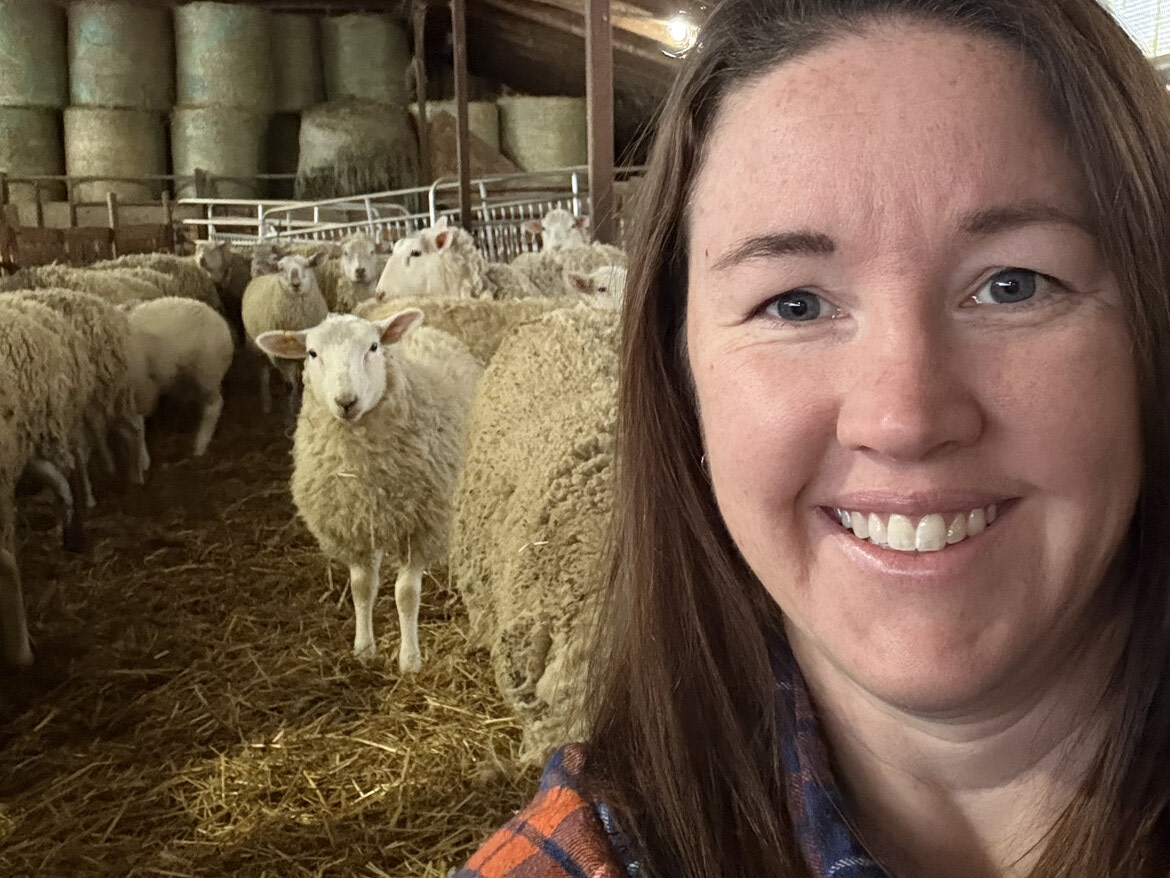
It is the first snow day of the year near Kincardine and, while most kids are sleeping in, Lindsay Dykeman’s three boys – aged nine, eleven and thirteen – are doing barn chores while she sits down for a phone interview with the Rural Voice. She laughs that they would probably rather be in school now, but she loves that they get to work in the same barn and grow up in the same house that she did.
“More than anything, we want to raise kids who can work hard and know how hard you have to work to make a go of things,” she says.
Lindsay comes from a long line of hard workers. Her grandparents bought the farm near Kincardine in 1951, and she is now the third generation at Klandon Farms. She and her husband Jeff bought the farm from her parents in 2012. Both have full-time jobs and Jeff crops 400 acres in organic wheat, spelt, soybeans, dried green peas, sunflowers and hay. The Dykemans are grateful for a small community of organic cash croppers in their area, the elevator in Ripley, and the support of their neighbour – Roland Hack.
As for Lindsay, she raises a flock of sheep in the barn. She is also the General Manager of the Ontario Dairy Goat Cooperative, secretary-treasurer of the Bruce County Community Pasture, on the board of the Kincardine Agricultural Society and the Bruce County Federation of Agriculture and is in the current class of the Advanced Agricultural Leadership Program (AALP). And her kids are into 4-H and hockey to boot!
As she sits down for the interview, it has been another long week for Lindsay. She was mid-way through a consultation with the dairy goat producers in Ontario in a bid for stable funding, then attended the Ontario Federation of Agriculture’s Annual General Meeting in Toronto.
There, she was honoured with the inaugural Peter Hannam Leadership Award, presented by his son, Greg Hannam of Woodrill Farms, and OFA President, Drew Spoelstra. Many readers will know Peter Hannam, the force behind First Line Seeds and the evolution of soybeans as a major crop here in Ontario, and that he passed away in 2025. His family and the Federation have created this award to honour his dedication to the industry.
The honour is well-deserved. Lindsay has worked tirelessly, both on and off the farm, to support the agricultural community. Perhaps she came by her leadership honestly. Her father, Ken Craig, often devoted his time to his community as a municipal councillor while he and his wife Nancy ran Klandon Farms as a dairy operation. He sold the cows to go to seminary and become a minister, leading a local Baptist church congregation for years and now serving as Kincardine’s mayor.
“My dad is also my number one choreman and my number one hype man,” Lindsay adds.
Lindsay was one of five children, and she wasn’t sure she would get the opportunity to farm. She grew up through the 4-H program and raised many types of animals in her formative years. The family would go to the Keady market every spring and get some goats, sheep or pigs to raise. She left the farm to get a degree in accounting at Nipissing University and came back to the area around 2007, working at BDO.
She wanted to raise some animals in the barn, but something manageable for her. So, on a trip back to the Keady market with her dad, she bought four black-faced Suffolk ewes. All had twins that year. Thus began the flock that she still has today, though she now breeds maternal composites which produce more lambs.
“The ewes are a mix of a lot of things, but they look like a Dorset, with a white face and they are slightly smaller,” Lindsay explains. “We’ve found that works best for us.” She explains that every producer has different preferences, some like the Texels or Charollais because they are “beefier.” In body size, not in taste, Lindsay clarifies.
At Klandon Farms, they lamb every other month. Sheep have a gestation period of five months, and lambs are sold at about 60 lbs at the Brussels sales barn, to be finished to 120 lbs for the meat market. The size of a flock can be grown or decreased relatively easily, depending on the market and how much time she has. Lindsay typically runs between 200-300 ewes, and has them shorn once a year, with a neighbour – Cody Ribbink – coming in to do it.
“There hasn't been much of a market for wool, not over the last 15 years I’ve been doing it, at least,” says Lindsay. “We do it because it’s an animal welfare issue, not because it is a revenue maker.” She goes on to explain that while some producers – like Romy Schill (Revolution Wool Company), Sandi Brock (Sheepishly Me) and Jennifer Osborn (Eco Wool)– have done a great job of marketing, it takes a lot of work. She wishes there was an easy way to sell the wool, because she is losing money just by delivering it to a depot.
There is a large market for lamb in Ontario and only 35 percent is filled by Ontario’s 3,000 producers, says Lindsay. The rest are coming from New Zealand or Australia, where they can produce sheep much more easily on year-round pasture.
But the goal of Ontario Sheep Farmers (OSF) is that 50 percent of the market be filled from Ontario-raised sheep. For forty years, the OSF has had stable funding due to a compulsory licensing fee (often called “check off”) that is now $2.20 per live animal. It has allowed the organization to do research and education, grow the market and help to shape policy.
“You need to have consistent funding or else you never know, from one week to the next, whether you're going to be able to support your operations,” explains Lindsay. And she has seen both sides, a voluntary and compulsory fee. Because while Ontario’s sheep producers have stable funding, the goat producers have not.
For the last three years, Lindsay has been working as the General Manager of the Ontario Dairy Goat Co-operative Inc. (ODGC). With nearly 100 members, it is one of the largest groups of dairy goat producers in the province. (Readers may recall that a previous General Manager of the ODGC was current MPP Lisa Thompson.)
Dairy goats have long been a rather precarious industry, Lindsay explains. Processors prefer not to deal with individual producers, so farmers organize into groups or work with a more centralized broker. Gay Lea Cooperative also has a dairy goat division, and there are smaller, local producer groups and brokers around the province. It is rare to see fluid milk on grocery store shelves, Lindsay continues, there is more of a demand for goat cheeses. About 85 percent of Ontario goat milk is processed into soft logs of chevre or feta-style cheeses.
Dairy goat milk quality and marketing are regulated under the Milk Act alongside cow’s milk but, unlike the rest of the dairy industry, Ontario’s dairy goat industry relies heavily on an export market to the U.S. They are often swept into international trade issues alongside the Dairy Farmers of Ontario (DFO), but without having a strong (and funded) organization to represent the entire industry.
“We have the same kinds of risks, but don’t have the protection of supply management,” Lindsay says.
Readers may be surprised to learn that Ontario’s goat industry doesn’t have stable funding. Ontario Goat began as a commodity group in 1951, has a voluntary membership and employs one part-time staff person.
“I’m often asked, ‘How do you guys not already have that?’,” says Lindsay. “And really, it’s complicated.”
To get a compulsory licensing fee for a commodity group, it needs to be granted by the Ontario Farm Products Marketing Commission under the Ontario Ministry of Agriculture, Food and Agribusiness (OMAFA). And the Commission will only grant the fee if the majority of producers vote in favour of it.
Lindsay explains that the goat industry has applied to the Commission both in 2012 and in 2017, but the producer votes failed both times due to fractures across the industry.
And this third attempt at stable funding is coming directly from the dairy side of the goat industry, explains Lindsay. Producers from both ODGC and Gay Lea Foods came together as a working group to form a new organization, the Dairy Goat Farmers of Ontario, and attempt to get stable funding (a compulsory licensing fee of less than one cent per litre) by the Commission under the Farm Products Marketing Act. Together, the members of the two co-operatives make up the majority of the 198 dairy goat producers – and 60,000,000 litres of goat milk produced annually – in the province. But the DGFO is a province-wide initiative and so the ODGC and Gay Lea have spent a lot of time working with other brokers and independent processors to join forces.
To grant the fee, the Commission requires that the purpose of the organisation in question is made explicit, and it will hold the organization to its purpose. In this case, the Dairy Goat Farmers of Ontario (DGFO) working group is clear that it will be engaged in advocacy, research, education and consumer awareness and will not have jurisdiction to create regulations, penalties, price-setting or a supply managed system. The working group also states that the DGFO would not replace existing co-ops and brokers, only work to create one voice for dairy goat producers in the province.
In late November and early December, a series of six consultations were held by the working group in five locations across the province, with another one online. It outlined a proposal of the fees, representation on the local board, and high-level by-laws for feedback. Lindsay admits that the consultation meetings have drawn out the people who are most opposed to the proposed changes.
Still, it is important to hear the concerns of all producers, and the working group has received valuable feedback about the structuring of the DGFO. The Commission will be running an Expression of Opinion Vote of all producers in January 2026.
Will the third time be a charm? It is hard to say. Lindsay feels it is important for farmers to work together, whether its helping neighbours out or joining across the province. She has seen firsthand as a sheep producer that stable funding gives commodity groups a voice and hopes that the goat industry will also rise to its potential over the next few years, whatever that will look like.
While farmers can’t control the weather, the border, or many other things in the industry, they can control how they show up for each other. ◊